These days I can feel the universe shifting, and something is appearing on the horizon.
Many writings ago, I had reconciled what it means to me to be an artist. Having recognised that in me resides an artistic soul and that being an artist as an occupation was not something I fully resonated with, I embodied my career from a much more authentic and enlightened place. Since then words like ‘cultural entrepreneur’, ‘social arts practitioner’, ‘educator’, ‘mediator’, ‘facilitator’ became just that - words, not labels. Words, not identities. Words - that describe the work I do, the mediums I use, and the way I operate as a freelancer.
At some point before I found myself on the other side, I came across one of Yumi Sakugawa’s reflection posts, and the prompts she had shared really helped to shift how I considered myself doing the work that I do. Here are some that really got me thinking:
What relationship do I want with my creative process?
What relationship do I want with the collective?
What role do I want to embody in collective care and liberation?
What does a resonant relationship between my creative offerings and aligned audience look like?
With these as a frame, I see more clearly the layers where my life and work connect with each other and am especially drawn toward opportunities where my different worlds collide most - at the same time recognising that my life and work are not so separate afterall.
I want to see the relationship with my creative process as a mutually nourishing partnership where I promise to expose myself to creative stimulus, to feed my creative spirit, as much as I allow myself to take creative breaks. I want to be able to activate, exercise, challenge and put my creative spirit to work while balancing its need to pause, recharge, receive and brew.
I want to serve and lead as an active cultural agent that influences, stirs, disrupts AND also one that facilitates, mediates and holds space. I want to always be the anomaly that breaks a pattern and the data point that raises questions.
I want to work with the ones who are open and ready to look into themselves, the ones that say “you never know until you try”, the ones who always felt they didn’t fully relate to the mainstream, the ones who exist a little on the outside, looking in and the ones who might not speak the common language. I want my work to offer space for them to exist and to be witnessed by others, while also witnessing themselves. A resonant relationship between my creative offerings and aligned audience will then be a generative one that ripples outward, with every new awareness and insight unlocked - a new portal that opens and connects with others.
As I continued to reflect about my current employment within an organisation and how it fits in the overall picture of my life and career, I came across the publication, The Artist Job Description/The Craft of Relations by Vijai Maia Patchineelam - who thought and wrote deeply about the artist’s role within an arts institution as part of his PhD research. I come from the perspective that an artist's existence is not confined to just arts and cultural institutions (or their personal studios), and so my takeaways from his publication are contextualised to my unique position.
Three years ago, I landed myself in this juicy spot of serving and practicing part-time under the education outreach role of a women's charity - knowing I was not the only artist who managed her career this way. In some form or other, the trajectory of a creative’s career (in Singapore) often involved securing a stable position of sorts, usually to nail down a stable source of income. That can look like a seasonal gig with predictable peaks, six-month or yearly contracts, or two years working full time only to quit and become freelance again.
Each of us would put on all these other hats as external working/practical roles that are mainly taken on to earn the dough to feed practice of the creative/artist soul - and for the years that I worked full-time, I thought that was the approach I adopted too. But when I left three years ago, I felt lost without the full-time identity. I thought, since I was no longer a full-time educator, does that make me a full-time artist? At that time, it didn't feel like so. To be an educator and to be an artist felt like two separate and completely different things, such that despite taking on creative projects outside the context of my full time educator role, I didn't credit those experiences to be ‘pure’ artist ones. The lens I had as an educator influenced many of my aesthetic, design and curatorial decisions that for the longest time I could not bring myself to consider them a part of my artist portfolio.
Where I am now is much more integrated and Patchineelam's research (some points raised mentioned artists being ‘onstage and offstage’ and ideas of ‘pure position’, the ‘embedded artist’ and ‘artists as parasites) and his presentation of it at artist talks really validated my perspective - that artists have become this elusive, mythical creature who works in mystical ways. And so, inspired by Patchineelam’s PhD research, I embarked on a writing exercise which I’ve come to title, The Evolution of An Artist's Job Description.
I started from a place of describing who I am and what I do using the plainest words with as little technical jargon and professional language as possible. Each time, I would make edits based on the copy before, with every version trying to get closer and closer to my most recent profile I've used in professional settings.
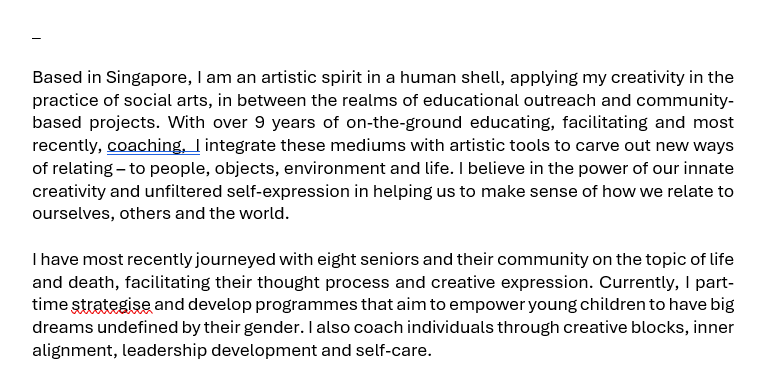
A screenshot of v5.0 of my profile
Here is what the exercise revealed to me so far:
The elusiveness of an artist is enhanced by how abstract the artist profile is (and my current profile does not help to clarify this)
The more plain I try to sound, the more clarity I have about who I really am and what I really do
What is important to include in the profile is to state clear where creativity comes in and to describe the mediums and tools that I use because this is fundamentally unique to an artist’s job and identity
At this point it seems more helpful not to call myself an artist in the profile and it is okay to include some professional language (as does everyone)
I see The Evolution of An Artist's Job Description as an ongoing piece, as far as the role and work of the artist continues to shift and evolve with the modern world and the advance of technology, and as more types of artist continue to emerge.
The way I see myself today is that the artist in me is my spirit and my creative compass that accompanies me to places led by my curiosity and the never-ending questions I want to find answers for. Whether this brings me to make paintings, sculptures, and illustrations, or produce videos and installations, or teach children and seniors and design programmes and experiences, my job description will keep changing because of that. While it is clear so far that I am definitely not a maker or a craftsmen, it does not exclude the fact that I can make things, because knowing how to use artistic tools is the fundamental part of the job.
It basically is very much like how an accountant knows how to use microsoft excel or how a writer knows how to construct sentences.