home is more than where the heart is
Notions of home is an ongoing inquiry I’ve had for about three years now. It started with a 4-week workshop I conceptualised for a family service centre in Chai Chee, whose demographic comprised of senior residents who had been relocated to Chai Chee in the later parts of their lives. Coming Home: A Prelude was born out of the belief that home is a forever place and that not all houses lived in would feel like home, influenced by my own experiences of moving to a new house in my early 20s where I recalled telling myself there will be no place that feels like home in the same way my childhood house did.
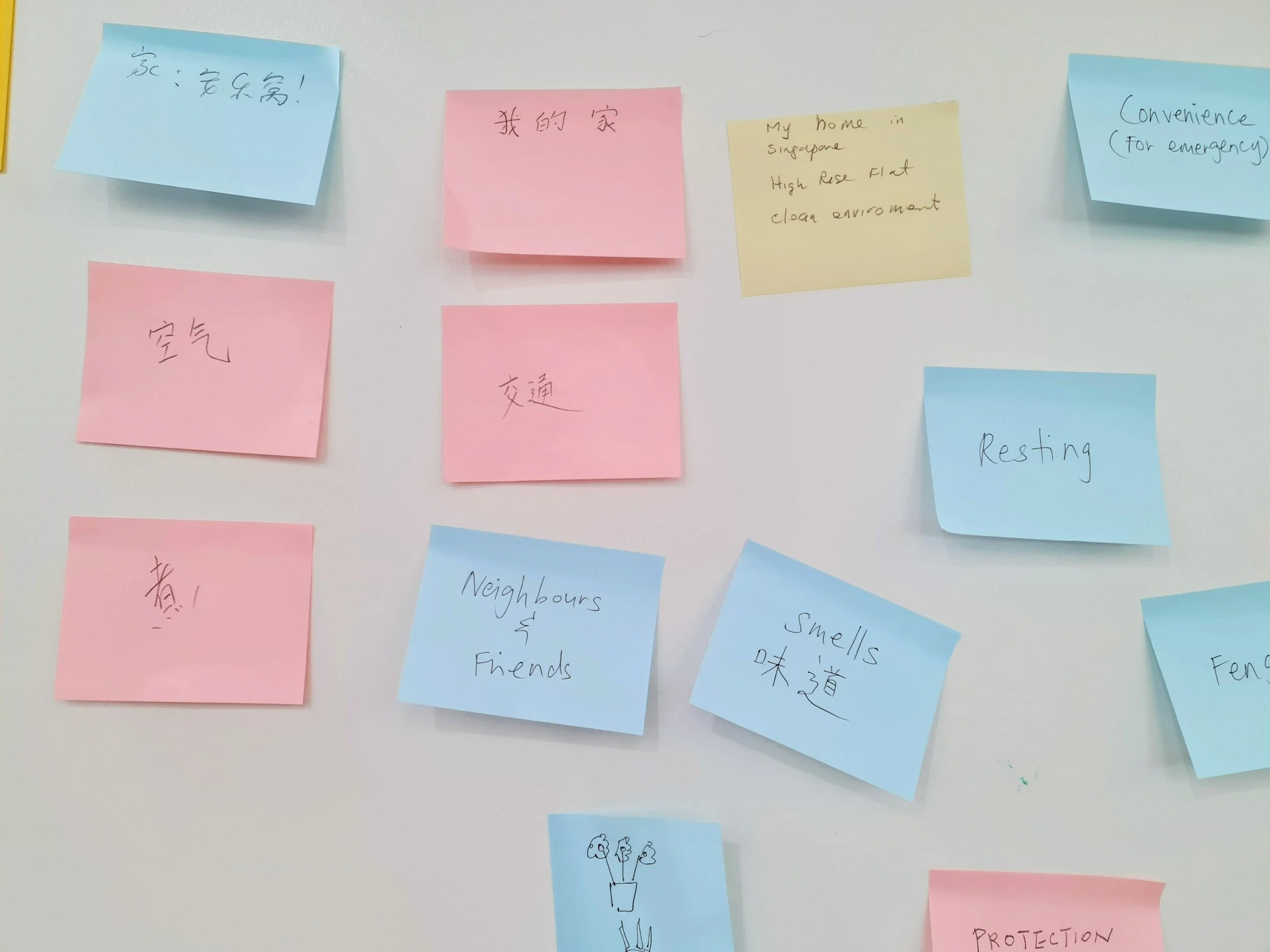
Responses by senior residents when asked what comes to mind when they thinking about the phrase “coming home”.
In the case of the senior residents who had been relocated at the later chapters of their lives, I wondered the same - how had their sense of coming home changed and where does the Chai Chee neighbourhood come in? The brief sensing during the four weeks revealed that most of the senior residents appreciated how daily errands can be done easily and conveniently - going to the supermarket, the bank, seeing friends, hosting family, religious worship. Besides these, a few mentioned nature - clean, fresh air, nice green parks, and safety as important elements that makes Chai Chee feel like home. Most of them had included the practical amenities and nature spaces in their mapping artwork, along with the people and activities they did in those spaces.
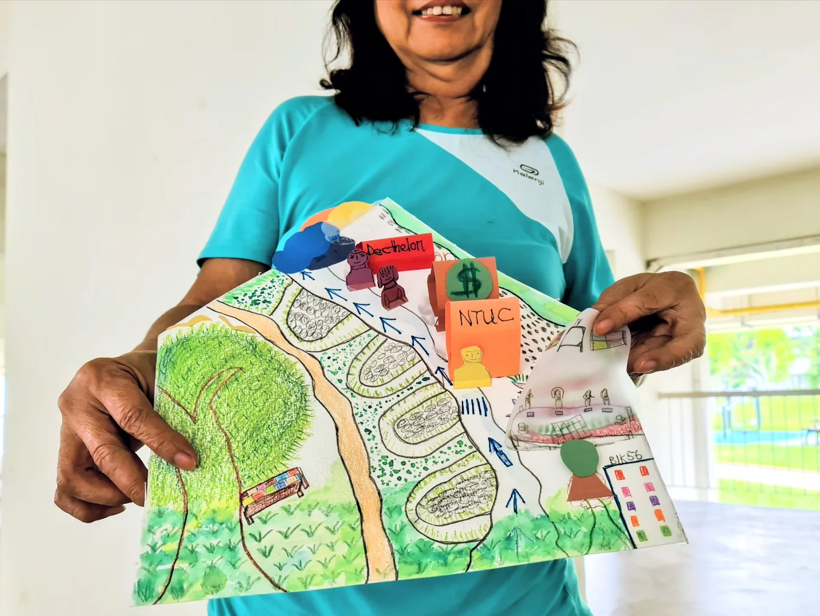
One of the senior resident’s mapping artwork where nature spaces play a big role and many joyful activities are centred around.
In my most recent endeavour, 金文泰之心 (At The Heart of Clementi), I saw it as an opportunity to go deeper into this inquiry, to find out what made certain places home and how that would differ for each individual. Can feelings of home be nurtured or cultivated and does time have a part to play? Besides sentiment, convenience and familiarity, what other elements contribute to one feeling at home in a place?
Seeing as how Clementi had only been my home since my early adult life, I did not have the same history with it as I did with Telok Blangah - my childhood home. If I considered Clementi with the same criteria as the residents of Chai Chee, Clementi as a home ticked most, if not all, of the boxes. I can run both personal and work errands with ease and get to places with no trouble at all. But what I realised really tipped the scale a little over to making Clementi feeling more like a home for me was when I managed to find a few go-to spots to spend quality time with myself. These places indicated to me feelings of safety, comfort and peace - which I originally least expected to find in the hustle and bustle of Clementi Town. Could this be one of the contributing factors to feeling at home in a place? Such that it allows you to just let down your guard and shed away the masks?
To get closer to the answer, I wanted to find out what kind of spaces offer this emotional safety - the safety to feel joy, grief, peace, wonder and awe - and if there were any specific spaces in particular that did. I was interested to know where people went to share secrets with each other, confide in one other, to laugh with each other and to wonder at the world. Through six prompts and twenty over street surveys on a September weekend, I arrived at having a better sense of what contributes to feelings of home - even if I now have more questions than answers.
Outside of convenience and practicality, to feel at home in a space (a house, building, neighbourhood, city, country), one should:
Be physically close to loved ones OR be able to do things with loved ones in that place
Be relationally close enough to the community where people recognise you and there is mutual regard
Be able to turn to nature as an element for joy, wonder and peace to exist in
Have place-based rituals for gatherings, prayer, exercise and play
Be able to spend quality alone-time - to people watch, read childhood comics, have a meal, make wishes and dream
With this list, I think now about my frequent trips to Florence where each time I spend about three weeks living a life there. As I type this while laying in bed, on what is already my fifth trip here, it bugs me that I do not yet feel at home in this city. Being unable to even call it my second or a third home makes me wonder what is missing. Despite the fact that my partner is here and that remote working helps me to maintain the regular rhythm of my life in Singapore, I think it’s possible that what has been missing all this while can be found in the points above.
Which brings back the question: Can feelings of home be nurtured or cultivated and does time have a part to play? Will a longer stay or more visits to this city help me to cultivate my feeling at home here? As I consider this, it is becoming clearer to me that feeling at home in a place represents a certain status of depth in the relationship you have with a space. To achieve this status, like any other relationship you have with people, you will have to build, cultivate, nourish and foster deep mental, emotional and spiritual relations and connections with said space. As the points above describe, those are exactly some of the ways such connections can form and be developed. On this note, if we used or move through spaces purely by function, it will be impossible to have a deep relationship with those spaces. This will make feeling at home and any other deeper relations, like sentiment and nostalgia, with that place further from reach.
Through 金文泰之心 (At The Heart of Clementi), I hope I can begin to uncover the depths of the relationships its community has with its spaces - the market and hawker centre, the bright blue stools around the courtyard, the sunset way canal bridge, the family-owned fabric shop, the bank, the fountain and more. And if not, I hope to at least use the project as an opportunity to come up with little ways we can build relationships with our spaces.