For the past few months or so, I've been noticing ants.
At first it was just the one, scurrying across my desk while I'm in a zoom call. Then it's another, climbing across my wall of drawings. A quick Google search later and I learnt that the thing with ants is, if you see one, you should know that the rest are somewhere near.
I tried all I can to find the source of where they were coming from but they did not even form a trail. As each day passed, more of them appeared in different corners of my room, but no matter how many times I vacuumed those soldiers away and how many ant gel poison traps I placed — they returned. By process of elimination, I was sure it was not because of any crumbs or half-eaten snack, and so I had to go with the next most likely cause - my bedroom plants. I have about five or six of them - my Swiss Cheese monstera (and her babies), the rubber trees, the philendrons - so it was time to do a stocktaking of this garden.
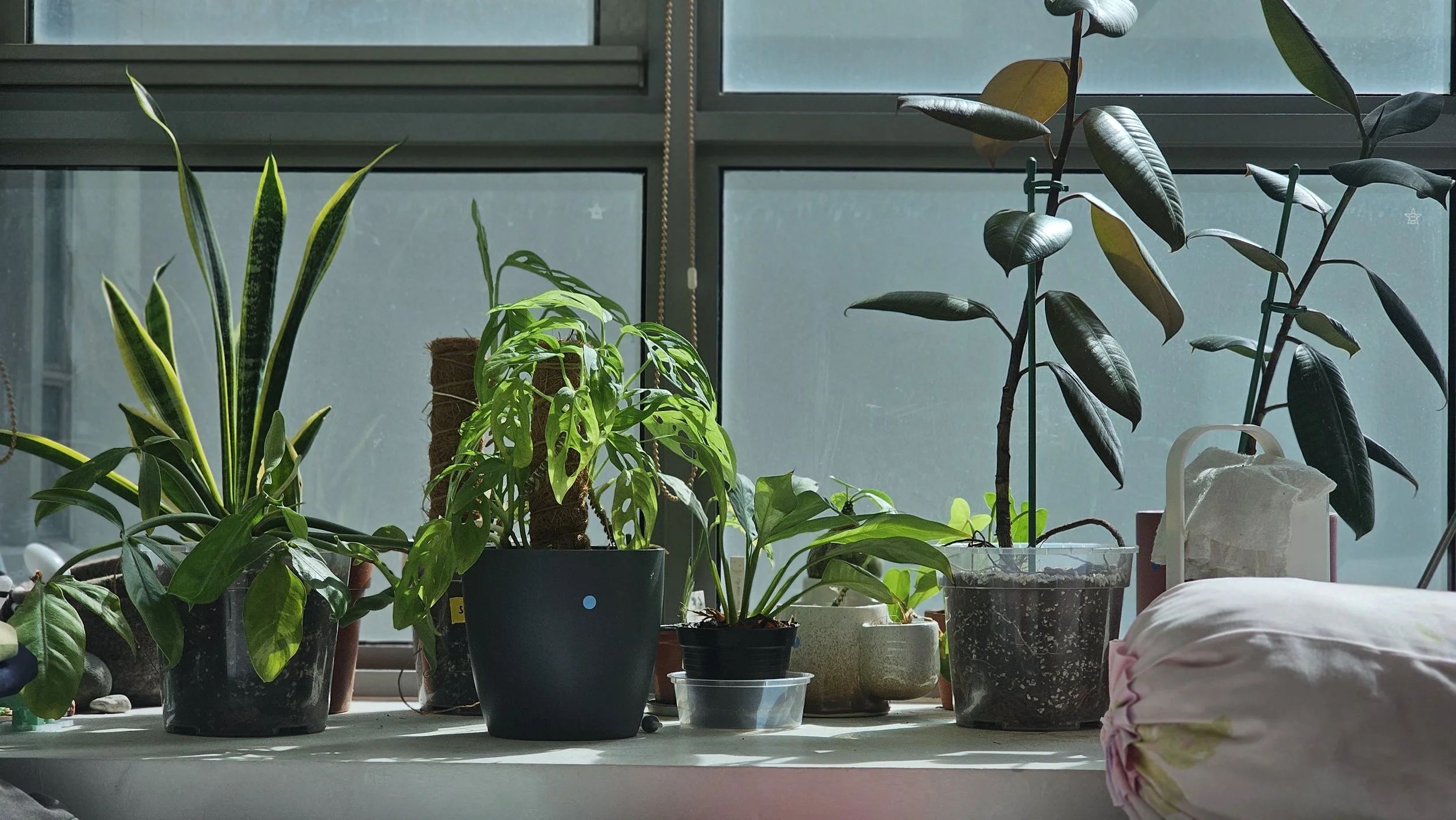
My bay window of plants.
At a glance, the plants were all doing well, as far as I could tell just looking over at my bay window. Each pot was sprouting a new leaf faster than I can keep track, no visible yellowing or browning on the leaves, no trail of ants coming out from any of the pots either - so where the hell are these ants coming from?!
I started with what I thought was the ‘troubled pot’ - maybe the one I watered too much some days ago and it smelled a bit too wet. It was not that one. Then I looked to the littlest pot of the group, a young Swiss Cheese monstera that has been taking awhile to grow compared to its siblings. It was hanging on the side of the window so you would think if it were infested with ants, I’d see a trail climbing up and down the wall. Instead I found a bunch of them scurrying around in the soil only after unearthing the monstera from its pot, busy building their nest I imagined. I cleared them out, gave it a fresh bed of soil, washed the ants off and felt confident my ant problem is officially over.
I was so wrong.
The ants came back with a vengeance. Back in the same pot AND now also in another bigger pot, and there was so many more of them! There was still no obvious trail in sight, but now I knew exactly where to lookout for them. When I took the plant out of its pot the second time, I observed. I was on my knees, crouched down low on the floor and peering deep into the soil poured out on sheets of newspaper - what are these ants up to in here? The colony seemed to have doubled and they were busy. Mostly carrying stuff, moving, building. Despite having washed the roots clean and giving it a fresh new soil bed, these ants came back. I thought they were probably drawn to something else I cannot see and this time somehow they felt more certain that they’ve found their home. In the other pot, the situation was the same. It was another Swiss Cheese monstera that was also slow in growth, but it was an older one with a decent bush of leaves and plenty of nodes where new roots can sprout from.
So I made the call to throw both of these away. Besides saving the healthy bush of leaves and retaining its nodes for a new set of roots, I threw the rest of them, along with their soil - ant colony and everything. For the sake of the rest of the other pots and not risking another ant infestation, it was a necessary step.
As I was tending to my bedroom garden and its ant infestation, it got me thinking about how this act looks like when applied to our inner garden. So here are my takeaways:
Observing is a compulsory and necessary act of tending. How often do we take the time to observe ourselves and what does that process entail? What will we see when we get down on our knees and peer into the depths of our soil? What will we find that needs tending to?
A plant may seem okay on the outside, but you will only know for sure through constant noticing. Noticing is not the same as looking. In noticing, you pause to see details and nuance, movement and stillness, growth and plateau - in your breath, in your thoughts, in your heartbeat.
The environment around these plants can tell you if the overall garden is healthy or not. Our internal state affects our external state, how we treat ourselves affects how we treat others and how well we are affects how we show up for ourselves, for others, at work, at home and in our lives.
Despite being in different beds of soil, individually potted plants can still affect each other. Everything is connected. Our physical health affects our emotional health, which also affects our mental health. If there is an aspect in your life that is neglected or not doing so well, it will affect other aspects to a certain extent.
Every pot has its own set of conditions and each of them needs its own set of care instructions. Care is never a one size fits all, even for the different areas within one person’s life. Every meal, routine, workout, film, podcast are variations of care that caters to the different needs that we have.
In the end, how do we know if our inner garden is healthy? What are the signs in the environment around us that we look out for? What are the different pots within this garden of our lives and what are their respective sets of care instructions? As I enter this season of intergration, I consider these takeaways as conscious acts and habits that I want to incorporate in the way I care for myself, tending to my inner garden. Tending is an ongoing process, and for it to have an impact, it must be a conscious, habitual act.
(PS: The ants came back and this time and they’ve infested a new pot. A bigger issue remains to be revealed, stay tuned.)
Update (16 Aug 2025): The ants are attracted to the scale insects! The brown spots on the leaves that I originally thought was just mould. I learn something new each day.